

Eczema Care
Bleach Baths vs. Hypochlorous Acid vs. Hypothesis™: Which Works Best for Eczema?
Over the past decade, scientists have established that a harmful bacteria called Staph aureus plays a critical role in driving eczema flares. Staph aureus colonizes 70–95% of eczema-prone skin, spikes dramatically right before flare-ups, and produces toxins that damage the skin barrier, amplify inflammation, and directly trigger itch. Studies have confirmed a clear relationship: the more Staph aureus on the skin, the worse the symptoms.
Because of this, dermatologists have begun recommending treatments specifically designed to reduce Staph aureus on eczema-prone skin. Three approaches have emerged as the most common: bleach baths, hypochlorous acid sprays, and precision enzyme therapy. Here's an honest comparison of how each one works and what each does to your skin's microbiome.
For a deeper dive into the role of Staph aureus in eczema, see our foundational guide, Eczema and the Microbiome: How Staph aureus Drives Flare-ups
Bleach Baths: The Surprising Truth
Bleach baths have been recommended by dermatologists for decades. The logic seems sound—bleach is a disinfectant, so soaking in a diluted bleach solution should reduce Staph aureus on the skin.
“The surprising finding: Studies show bleach baths don't actually reduce Staph aureus.”
A randomized clinical trial found no significant reduction in Staph aureus colonization from bleach baths compared to plain water baths. A separate study concluded that the diluted concentrations used in baths are simply too low to directly inhibit Staph aureus.
Still, some people do find bleach baths helpful. A systematic review of clinical studies found that consistent bleach bath use led to a roughly 22% improvement in eczema severity on average with about 1 in 10 users seeing 50% improvement. The exact mechanism isn't fully understood, but may involve potential anti-inflammatory effects.
Bleach baths are low cost and require no prescription, which makes them accessible. But they require careful dilution and 2–3 sessions per week, which can be a hard routine to maintain.
Bottom line: Bleach baths are accessible and can improve eczema symptoms for some people, but not by addressing Staph aureus. Results are modest for most users, and the routine can be hard to stick with.
Hypochlorous Acid: A Broad-Spectrum Disinfectant
Hypochlorous acid (HOCl) sprays have become increasingly popular for eczema. Unlike bleach baths, hypochlorous acid does reduce Staph aureus on the skin, which likely explains the benefits some users report. It's easy to apply as a spray, and, like beach baths, may also have some anti-inflammatory properties.
But there's an important catch. Despite some marketing claims suggesting otherwise, hypochlorous acid is well-known to be a broad-spectrum disinfectant. It doesn't distinguish between harmful and beneficial bacteria—it eliminates both.
"Every time you use hypochlorous acid, you are wiping out your skin microbiome."
The research on this is striking. In one of the only studies to examine hypochlorous acid's effect on the skin microbiome directly, application reduced total bacterial load by more than 90%, with a loss of more than half the species in the microbiome. S. epidermidis—an important beneficial bacteria—decreased by more than 99.5%. This is consistent with in vitro studies that show hypochlorous acid rapidly kills all skin bacteria that were tested. Every time you use hypochlorous acid, you are wiping out your skin microbiome.
This matters because beneficial bacteria play a critical role in skin health. They strengthen the skin barrier, regulate the immune system, and maintain healthy skin pH. They also compete against harmful bacteria for space and resources. When the microbiome is depleted by a broad-spectrum disinfectant, it doesn't always rebalance after treatment. Without beneficial bacteria to keep them in check, harmful bacteria can actually recolonize faster—potentially worsening imbalances over time.
Bottom line: Hypochlorous acid reduces Staph aureus, but at the cost of significant microbiome disruption. Think of hypochlorous acid as a disinfectant or sanitizer that kills all bacteria rather than a targeted treatment. The disruption to the microbiome is a meaningful trade-off that’s usually not acknowledged.
Side-by-Side Comparison


Precision Enzyme Therapy: A Different Approach
The limitations of broad-spectrum antimicrobials have led researchers to explore a fundamentally different question: what if you could target harmful bacteria selectively without disrupting the beneficial microbiome at all?
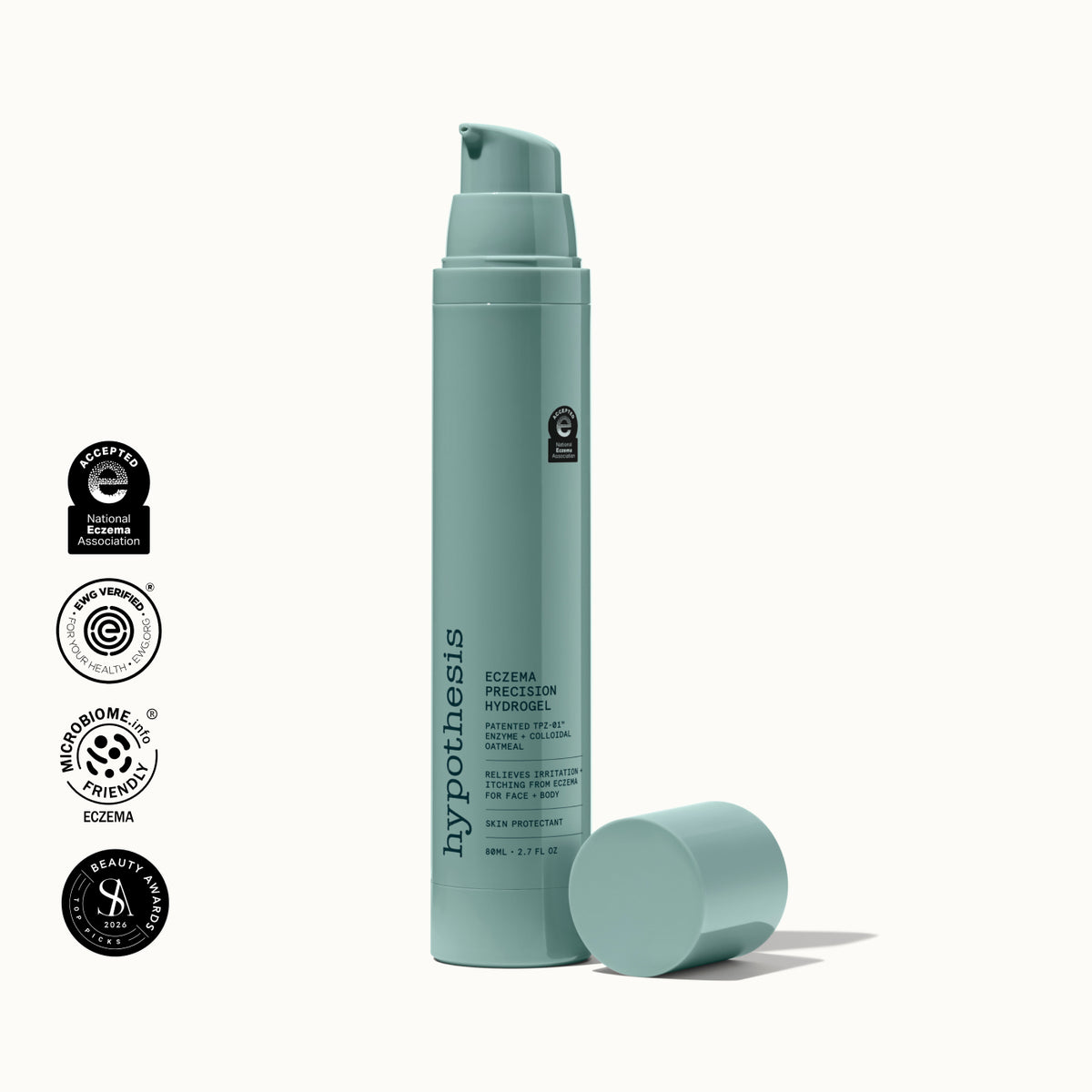
This is the principle behind TPZ-01™, a patented precision enzyme developed by hypothesis™. TPZ-01™ belongs to a class of naturally-occurring enzymes called lysins (or endolysins). Unlike broad-spectrum antimicrobials that act on all bacteria, lysins can be engineered to target one specific species of bacteria while leaving everything else undisturbed.
If bleach and hypochlorous acid are like carpet bombing your skin microbiome, TPZ-01™ is like a precision strike that just targets Staph aureus.
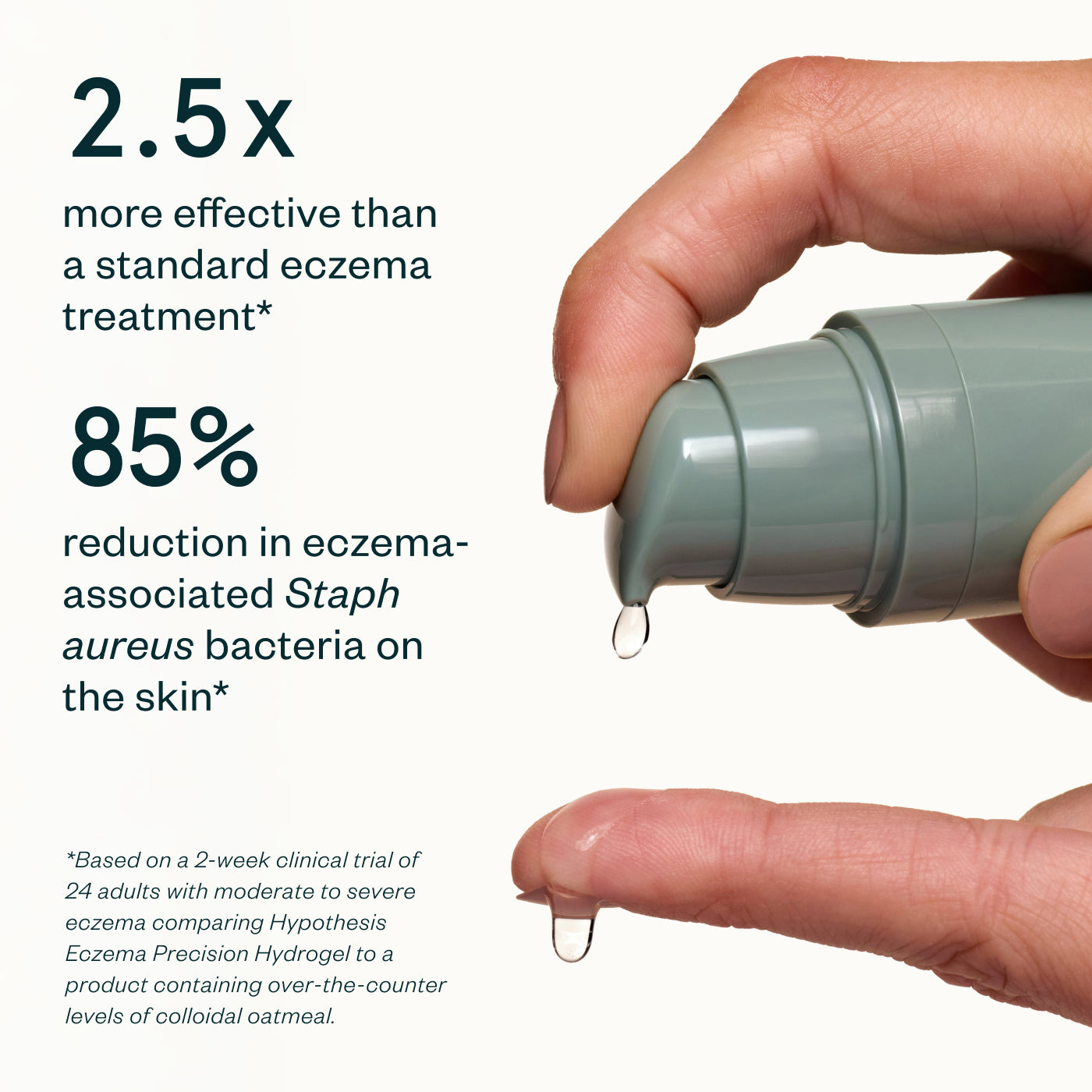
The clinical evidence supports this approach. In laboratory testing, TPZ-01™ eliminates 99.99% of Staph aureus within 5 minutes with no measurable effect on beneficial bacteria including S. epidermidis and Corynebacterium species. In a dual-arm, formulation-controlled clinical trial—the gold standard for isolating an ingredient's specific contribution—participants using the hypothesis™ Eczema Precision Hydrogel saw a 62% reduction in eczema symptom intensity versus 25% in the identical formula without TPZ-01™. The same trial demonstrated an 85% reduction in Staph aureus on the skin, with microbiome diversity maintained and balanced throughout.
Because the beneficial microbiome is preserved rather than depleted, the skin's natural defense ecosystem remains intact. This supports lasting balance rather than the recolonization cycle associated with broad-spectrum treatments, and it means TPZ-01™ is appropriate for daily long-term use, including in infants.
Bottom line: Precision enzyme therapy is the only approach that selectively targets Staph aureus while preserving the beneficial microbiome—with clinical trial data to support it. This new enzyme technology is the only option that addresses the bacterial driver of flares without microbiome trade-offs.
The Verdict
All three approaches aim to address the bacterial component of eczema, but they work in fundamentally different ways and produce meaningfully different outcomes for the skin microbiome. Bleach baths are accessible but don't demonstrably reduce Staph aureus. Hypochlorous acid reduces Staph aureus, but depletes the beneficial microbiome in the process.
Precision eczema care with TPZ-01™ targets Staph aureus selectively, addressing the bacterial driver of flares while leaving the microbiome intact.This enzyme technology is clinically validated to deliver more than double the improvement in eczema symptoms of typical eczema treatments.
Frequently asked questions
Can I use hypochlorous acid and hypothesis™ together?
You can, but it may work against the same goal. Applying a broad-spectrum disinfectant alongside a precision enzyme designed to preserve your microbiome creates conflicting approaches.
Are bleach baths safe for children and infants?
Bleach baths are sometimes recommended by dermatologists for children with eczema but should always be done with careful dilution and with medical guidance. Hypothesis™ Eczema Precision Hydrogel and Precision Healing Spray are safe for daily use from infancy onward, and have received the MyMicrobiome Eczema certification for both adults and infants.
How long does TPZ-01™ take to work?
In our clinical trial, participants saw meaningful improvement within two weeks of consistent twice daily use. As with any eczema care, consistency matters. Daily use as part of a complete routine produces better outcomes than occasional application.
Can I use hypothesis™ alongside my existing eczema routine?
Yes — hypothesis™ products are designed to complement your existing routine rather than replace it. Moisturizers address the skin barrier, steroid creams calm inflammation, and TPZ-01™ addresses the bacterial driver that neither of those treatments touches.